
Pennsylvania Death Index Records
Pennsylvania death records are official documents maintained by the Bureau of Health Statistics and Registries, which serves as the state's custodian of vital records dating back to January 1906. Death certificates record key facts about a person's passing, including the name, date, county, and cause of death. Researchers use these records for family history work, settling estates, and legal matters. You can search the Pennsylvania Death Index online through the PA State Archives, order certified copies from the Division of Vital Records, or visit one of six public offices across the state. This guide explains what records exist, where to find them, and how to get what you need.
Pennsylvania Death Index Quick Facts
Accessing the Pennsylvania Death Index
The PA State Archives provides free online access to the Pennsylvania Death Index for deaths from 1906 through 1975. You can search this index at the PA State Archives Death Indices page. The index contains the full name of the deceased, the date of death, the county, and the State File Number. That file number is required if you want to order a certified copy of the full death certificate. No fee is charged to search or view the index.
For deaths after 1975, the index is not publicly available online. You can still order certified copies directly from the Division of Vital Records. The PA State Archives vital statistics records page explains what is available online and what must be requested through official channels. Many researchers begin with the free index to confirm a death event and locate the file number before ordering the full certificate.
The PA State Archives vital statistics records research page is a useful starting point for any Pennsylvania death records search.
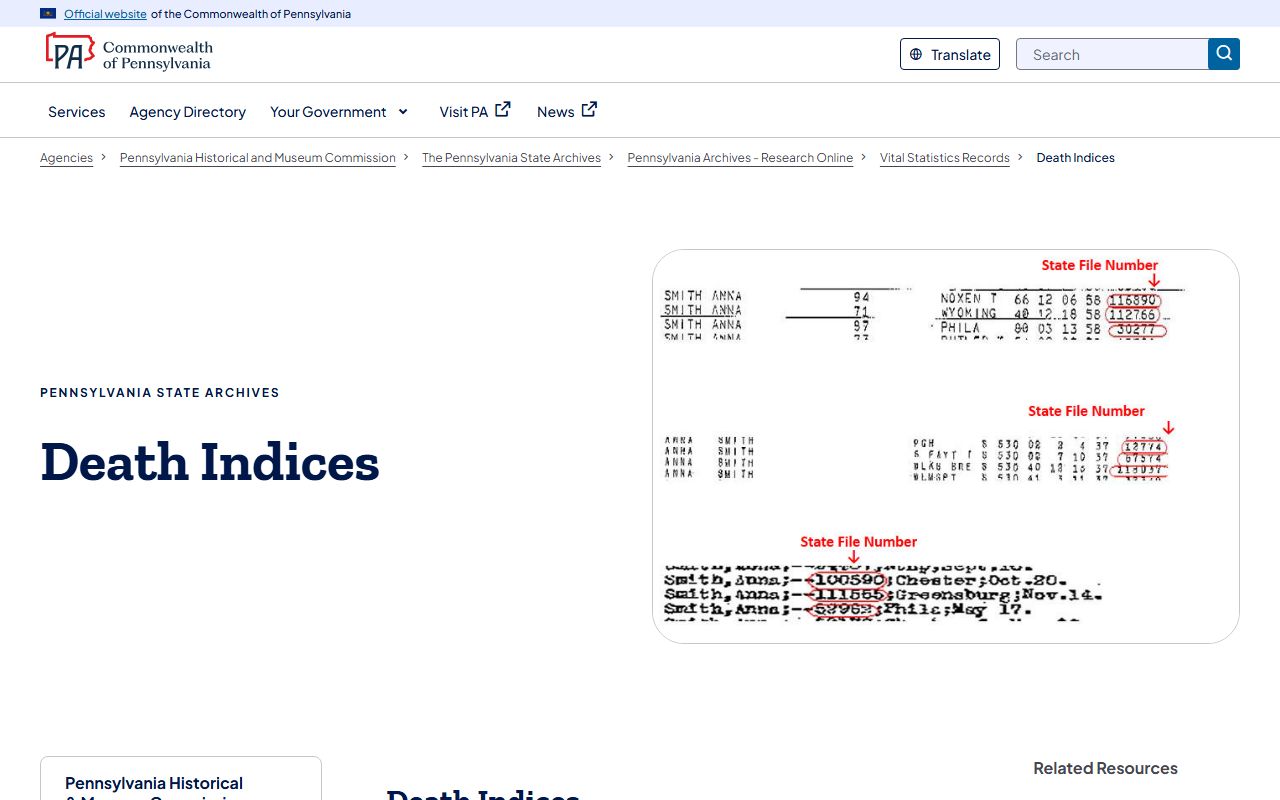
The archives hold original death records and offer guidance on how to request copies for research and legal use.
Note: The State File Number from the death index is required to order a certified copy of the full death certificate from the Division of Vital Records.
What Pennsylvania Death Certificates Contain
Pennsylvania death certificates come in two types. The first is a death certificate with medical information. This version includes the cause of death, the manner of death, and other medical details completed by the attending physician or coroner. The second type is a death certificate without medical information. This version excludes those medical details and is only available for deaths that occurred after 2019. The version you need depends on your reason for requesting the record.
Both types include basic identifying facts: the full name of the deceased, the date of death, the place of death, the decedent's age and date of birth, the names of parents or spouse, the place of burial, and the county where the death occurred. Death certificates are used for closing financial accounts, settling estates, claiming life insurance and pension benefits, and as documentation for remarriage. When you order a certificate, confirm which type you need before submitting your request to avoid delays.
The Pennsylvania Department of Health vital records page outlines what you can order and how.
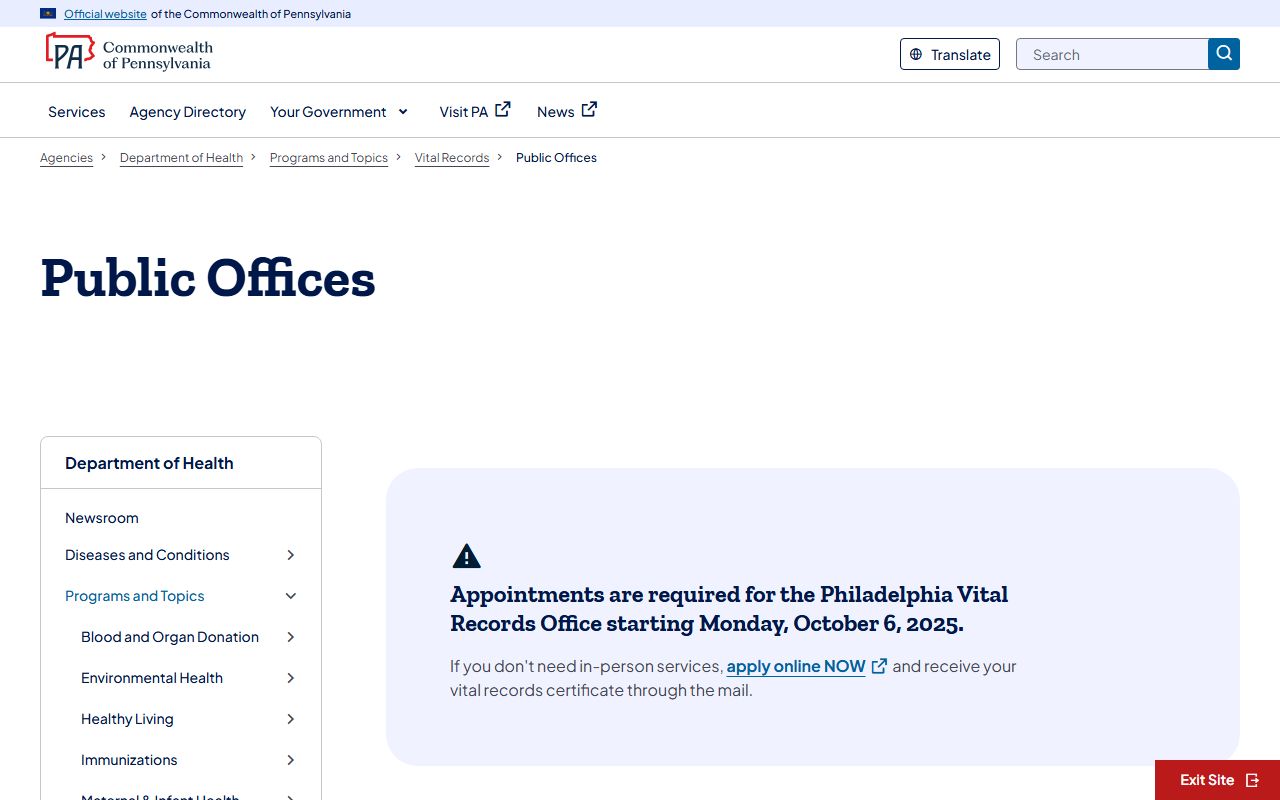
The ordering page walks you through eligibility, fees, and the steps for submitting a request online or by mail.
Pennsylvania Death Records by Historical Era
Pennsylvania's death records do not follow a single uniform system across all time periods. The way records were kept and indexed changed several times over the decades. Understanding those differences helps you search more effectively, especially for older records.
Death certificates and birth certificates have been recorded statewide since January 1906, when Pennsylvania established a central vital records system. Before that date, from 1893 to 1906, births and deaths were recorded by the Clerk of Orphans Court at each county courthouse. Going further back, from 1852 to 1854, records of birth, marriage, and death were kept by the Register of Wills for each county. Returns from that period are available for 49 of the 64 counties that existed at the time. For deaths before 1906, the best place to start is the courthouse in the county where the person died.
Digital copies of death certificates from 1906 to 1972 are available on Ancestry.com. Pennsylvania residents can access Ancestry.com records for free through the state's partnership with Ancestry. That partnership makes it easier to search historical records without a paid subscription for those who live in the state.
The CDC Where to Write page for Pennsylvania vital records is another helpful reference for researchers.
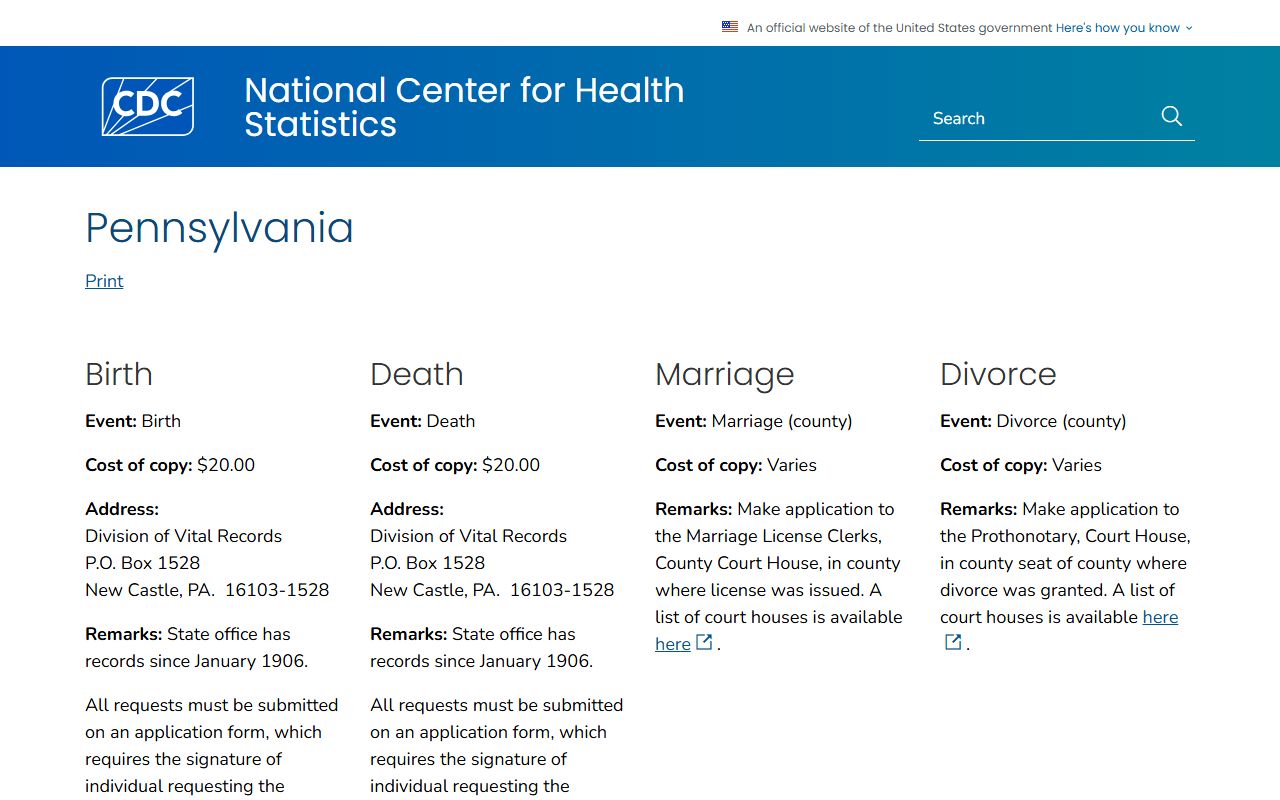
This federal resource lists contact details and availability for Pennsylvania vital records going back to the earliest statewide registration period.
Note: Pennsylvania death certificates before 1906 can be accessed through the courthouse in the county where the person died, not through the Division of Vital Records.
How the Pennsylvania Death Index Is Organized
The Pennsylvania Death Index from 1906 to 1975 is divided into several distinct periods, each organized differently. Knowing which period applies to your search will save time and reduce confusion when you look up names.
From 1906 to 1919, the indices are organized by surname groups without Soundex coding. You browse alphabetical groupings within each year. From 1920 to 1924, and again from 1930 to 1951, the index uses the Russell Soundex method. Soundex groups surnames that sound alike under a code, so spelling variations are easier to find. From 1952 to 1975, the index returns to alphabetical surname groupings. The period from 1925 to 1929 follows its own arrangement as well. If you are not sure how a name was spelled, searching surrounding years and using Soundex codes for applicable periods will improve your results.
Birth and death records become public records 105 years after the date of birth and 50 years after the date of death in Pennsylvania. Once those thresholds are met, access is broader and fewer restrictions apply. The Division of Vital Records does not issue uncertified copies for genealogical purposes. Only certified copies are available from that office. If the record you request cannot be found, the office will issue a "No Record Certification of Death" to confirm the search was completed.
Note: Searching under alternate spellings and Soundex codes for periods between 1920 and 1951 can help you find records for surnames with inconsistent historical spelling.
How to Order Pennsylvania Death Certificate Copies
The Division of Vital Records handles all requests for certified Pennsylvania death certificates. You can order online, by mail, or in person at one of six public offices. Each method gives you a certified copy that is accepted for legal purposes. Processing times and fees vary by method.
Online ordering is available at mycertificates.health.pa.gov. The base fee is $20 per certificate. Online orders carry an additional $10 processing fee. VitalChek is the only authorized online vendor for Pennsylvania death certificates. Do not use other third-party sites that claim to offer Pennsylvania death records, as VitalChek is the sole official channel for online requests.
Mail applications go to: Division of Vital Records, Death Certificate Processing Unit, PO Box 1528, New Castle, PA 16103. You can reach the office by phone at 724-656-3100 or toll-free at 844-228-3516. Phone hours are Monday through Friday from 7:15 AM to 6:00 PM, and weekends from 8:30 AM to 4:00 PM.
The VitalChek ordering service provides a fast and convenient option for those who need certified copies quickly.

VitalChek processes Pennsylvania certificate requests and ships copies directly to the requestor after verification.
Note: Mail requests take longer to process than online orders, so plan ahead if you need a certificate by a specific date.
Pennsylvania Death Records Public Walk-In Offices
Pennsylvania operates six public offices where you can request death certificates in person. Walk-in service is available Monday through Friday from 8:00 AM to 4:00 PM at all locations. Same-day service is possible if you arrive before 2:30 PM. The Philadelphia office has an earlier same-day cutoff at 10:00 AM, so plan your visit accordingly.
The six PA Division of Vital Records public offices are located at:
- Harrisburg: 555 Walnut St
- New Castle: 105 Nesbitt Rd
- Philadelphia: 110 N. 8th St (same-day cutoff 10:00 AM)
- Pittsburgh: 411 7th Ave, Rm 360
- Scranton: Scranton State Office Bldg, Rm 112
- Erie: 156 E 14th St
Bring a valid photo ID and payment when you visit. You should also bring any information you have about the deceased, including the full name, date of death, and county. If you already have a State File Number from the death index, bring that too. It will speed up the process at the counter. Staff at each office can help you determine which type of certificate you need.
The Pennsylvania Department of Health genealogy records page provides additional details about accessing older records and what to expect when requesting documents.
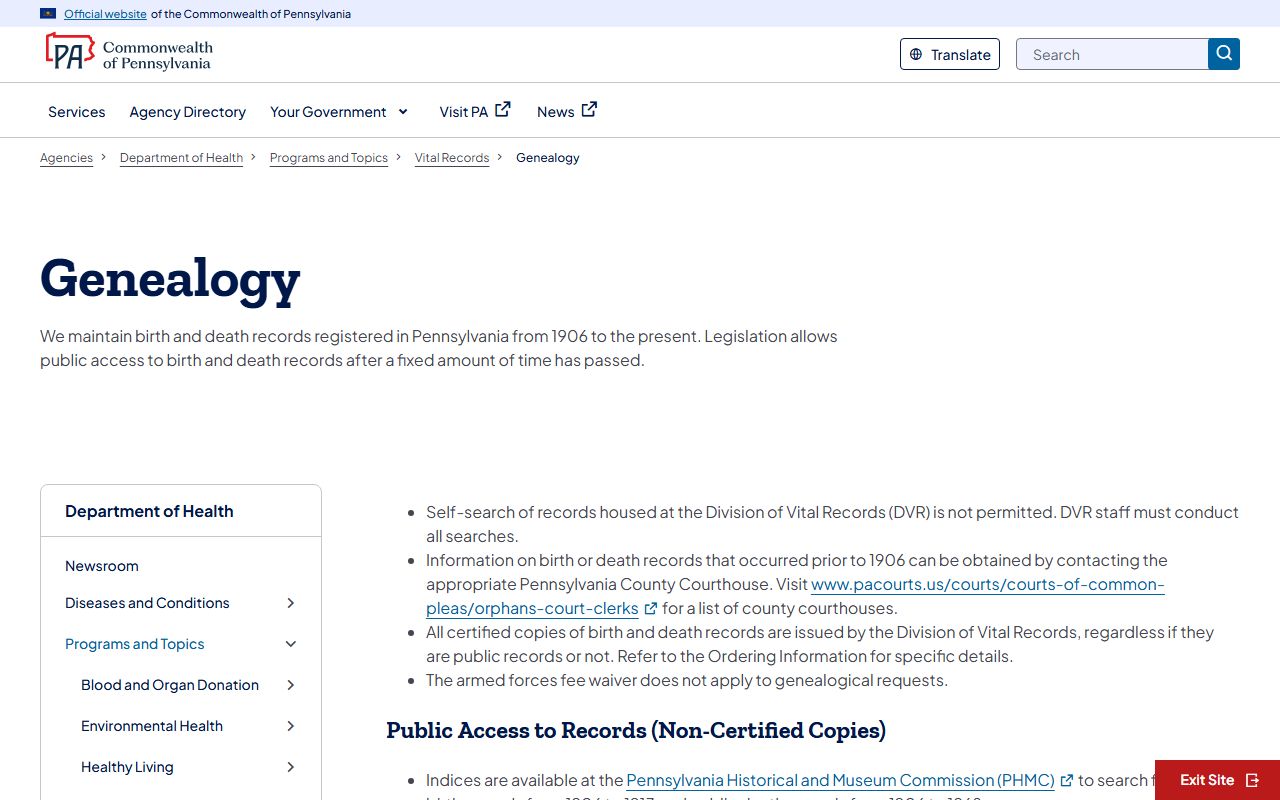
This page covers genealogy-specific access rules, including the 50-year and 105-year thresholds that determine when records become publicly available.
Note: Walk-in offices can be busy, and arriving early in the morning reduces wait times at all six Pennsylvania locations.
Who Can Request Pennsylvania Death Records
Not everyone can order a certified copy of a Pennsylvania death certificate. The state limits access to specific groups of people to protect the privacy of those named in the records. You must fall into one of the eligible categories to receive a certified copy from the Division of Vital Records.
Eligible applicants include: the spouse or ex-spouse of the deceased, a parent or step-parent, siblings, children or step-children, grandparents, grandchildren, an individual holding power of attorney, attorneys and legal representatives, and any person who can demonstrate a direct and tangible financial interest in the record. If you do not fall into one of these groups, you may still access the free public death index through the PA State Archives for deaths from 1906 to 1975. The full certificate, however, requires eligibility.
Members of the U.S. Armed Forces receive a fee waiver for up to 10 copies of a death certificate per year. This benefit applies to active duty members and eligible veterans. Request the waiver at the time you submit your application. Proof of military status is required to claim the waiver from the Division of Vital Records.
Note: If your request is denied, the Division of Vital Records will explain the reason, and you may be able to resubmit with additional documentation to establish eligibility.
Pennsylvania Death Index Genealogy Research Tips
Genealogical research using Pennsylvania death records requires knowing where to start and what each source can tell you. The free death index from the PA State Archives covers 1906 to 1975 and is the fastest way to confirm a death and obtain a State File Number. From there, you can request the full certificate to get cause of death, place of burial, and informant details. Those leads often point to other records and family connections.
For deaths after 1975, you must order directly from the Division of Vital Records at pa.gov/agencies/health/programs/vital-records/death-certificates. You need to meet the eligibility rules, which means providing your relationship to the deceased. If you are researching a distant ancestor and do not qualify under current eligibility rules, wait until the 50-year mark from the date of death has passed. At that point, the record becomes more broadly accessible.
For records before 1906, start with the county courthouse. The Clerk of Orphans Court handled death registrations from 1893 to 1906. For the 1852 to 1854 period, the Register of Wills kept the records. Church registers, cemetery records, and newspaper obituaries can fill in gaps when official government records do not exist. The PA State Archives also holds a wide range of supplemental historical records that support genealogical work.
Note: Digital images of Pennsylvania death certificates from 1906 to 1972 on Ancestry.com allow you to view the actual document without ordering a certified copy, which is useful for research purposes.
Browse Pennsylvania Death Records by County
Pennsylvania's most populated counties hold the largest collections of death records. Select a county below to find local resources and death record information for that area.
Death Records in Major Pennsylvania Cities
Select a city below to find death record resources and local office information for that area of Pennsylvania.